Steriotriqs
Drift Node
Drift Node
Couldn't load pickup availability
1. Problem Statement
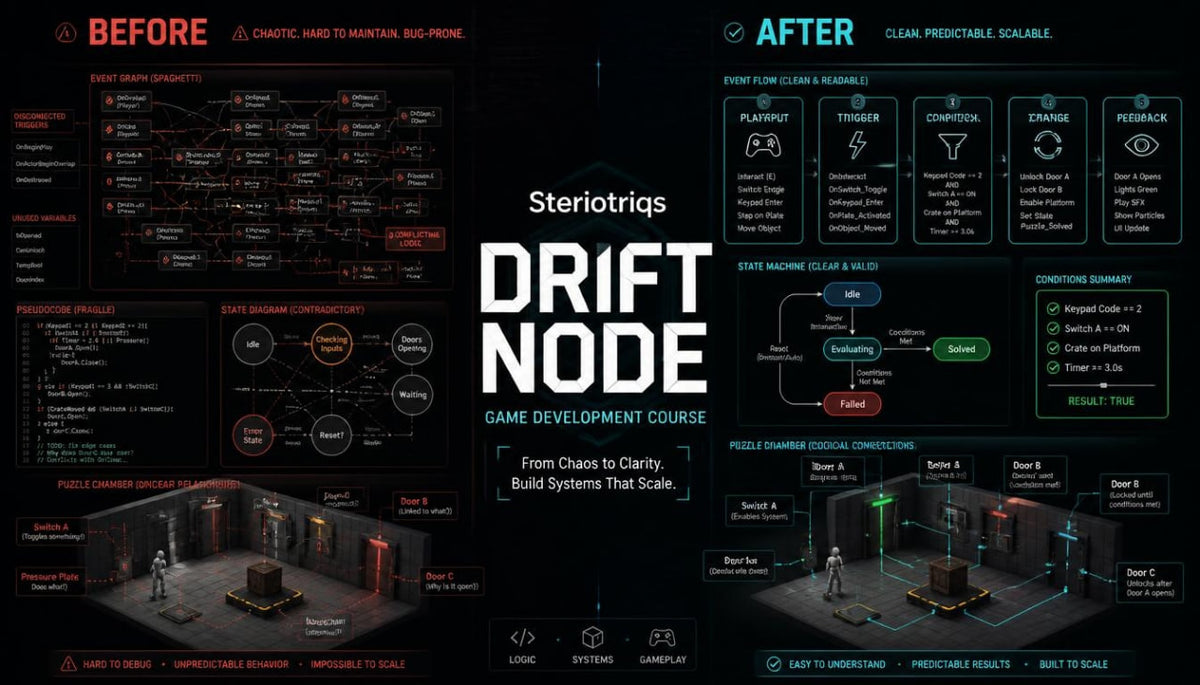
Creating an interactive game involves more than designing characters and environments. Every player action interacts with rules, conditions, and events that influence how gameplay develops. Beginners often struggle to understand how these separate components communicate within a structured system. Without clear organization, even small gameplay concepts can become difficult to describe, modify, and evaluate. Understanding the relationships between events, states, and interactions provides a foundation for examining larger development structures.
2. Solution
Drift Node introduces a structured approach to planning and describing interconnected gameplay systems. The course examines how events trigger actions and how conditions influence the behavior of interactive elements. Learners explore practical methods for mapping interactions, documenting state changes, and organizing gameplay rules. Each module combines conceptual explanations with examples drawn from fictional game scenarios. Guided activities encourage learners to build diagrams, evaluate interaction sequences, and develop organized gameplay specifications.
3. What's Inside
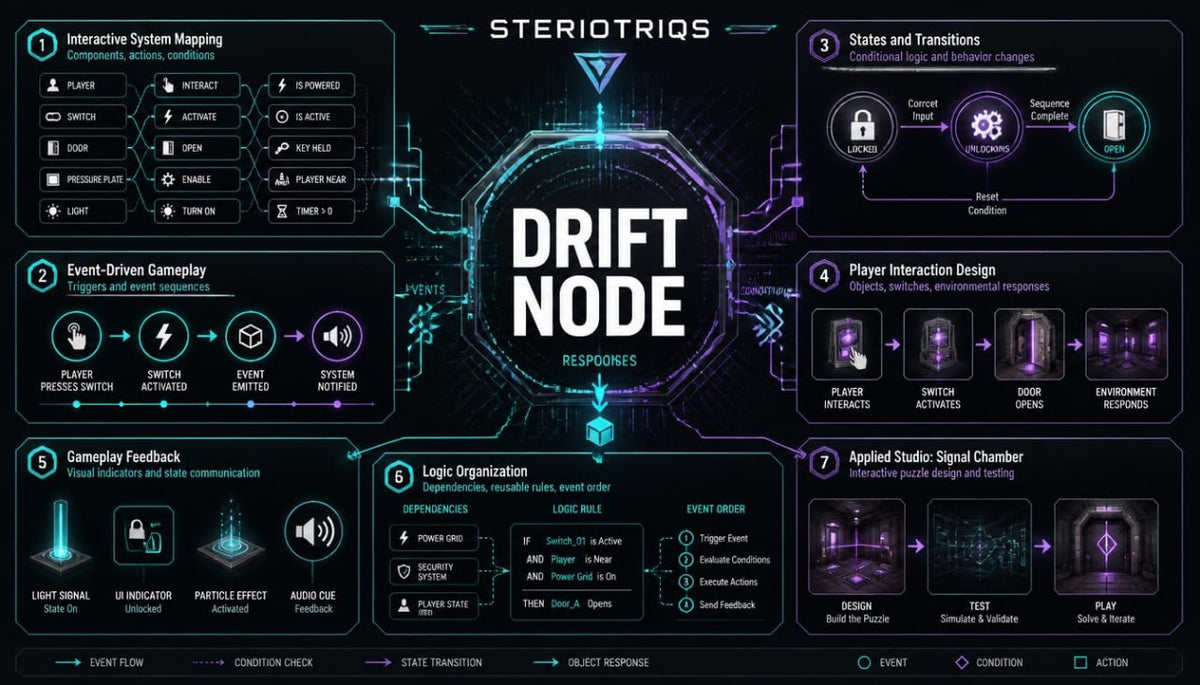
Module 1 — Mapping the Structure of Interactive Systems
Explore the relationship between gameplay components, actions, conditions, and responses. Learn how to represent interactive behavior through diagrams and written specifications, using a fictional puzzle environment to illustrate connections between individual game elements.
Module 2 — Events That Shape Gameplay
Examine event-driven gameplay structures and the processes behind triggering actions. Study how player inputs, environmental changes, and internal conditions generate events, then practice documenting event sequences using structured examples.
Module 3 — States, Conditions, and Transitions
Investigate how game objects move between different states during gameplay. Explore conditional logic, transition rules, and state diagrams while designing a small interaction system with clearly defined behavior patterns.
Module 4 — Connecting Objects and Player Actions
Study relationships between interactive objects and player-controlled actions. Examine switches, movable objects, collection mechanics, and environmental reactions through practical scenarios that demonstrate how separate elements contribute to connected gameplay.
Module 5 — Designing Gameplay Feedback
Explore how interactive systems communicate changes to players through visual indicators, movement responses, interface elements, and environmental adjustments. Practice describing feedback rules that correspond to specific gameplay events and conditions.
Module 6 — Organizing Gameplay Logic
Learn to divide complicated interaction sequences into smaller functional components. Examine reusable rules, dependency relationships, event ordering, and basic troubleshooting methods while outlining a connected gameplay system.
Module 7 — Applied Studio: The Signal Chamber
Develop a written specification for a fictional interactive puzzle chamber containing switches, doors, moving objects, and conditional pathways. Create interaction diagrams, describe event sequences, establish state rules, and prepare a compact testing checklist.
4. Who Is This For?
Drift Node is intended for beginners who have explored introductory game development concepts and want to examine gameplay logic in greater detail. It also suits learners interested in interactive design, event structures, and system organization.
The course emphasizes conceptual planning and introductory technical reasoning rather than advanced programming or complete game construction.
5. What You'll Learn
- Describe relationships between gameplay components.
- Create introductory event and interaction diagrams.
- Define object states and transition conditions.
- Organize player actions into structured sequences.
- Describe feedback mechanisms for interactive events.
- Identify dependencies within gameplay systems.
- Document and evaluate a small interactive puzzle concept.
6. 14-Day Refund Policy
Customers may submit a refund request within 14 days of purchasing Drift Node, subject to the conditions outlined in the Steriotriqs Refund Policy.
Requests can be submitted through our contact channel, where our support team will review the purchase details and applicable refund conditions. The complete policy provides further information about eligibility and request procedures.
Share