Steriotriqs
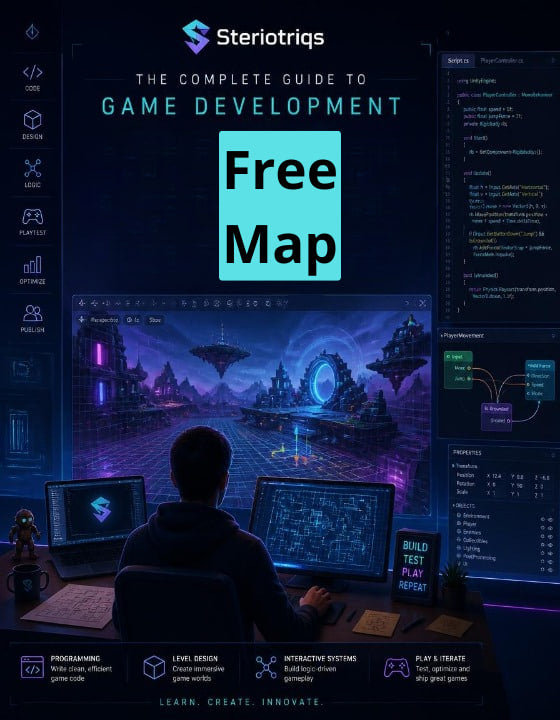
Free Map
Free Map
Couldn't load pickup availability
1. Problem Statement
Game development brings together several interconnected disciplines, including creative design, programming logic, interactive systems, and visual composition. For newcomers, understanding how these elements relate to one another can feel challenging without a structured learning direction. Many introductory explanations focus on isolated concepts without demonstrating how they contribute to a complete game experience. This fragmented approach can make it difficult to distinguish between gameplay design, technical implementation, and the organization of development tasks. A clear introduction to these relationships provides a useful foundation for exploring more detailed game development topics.
2. Solution
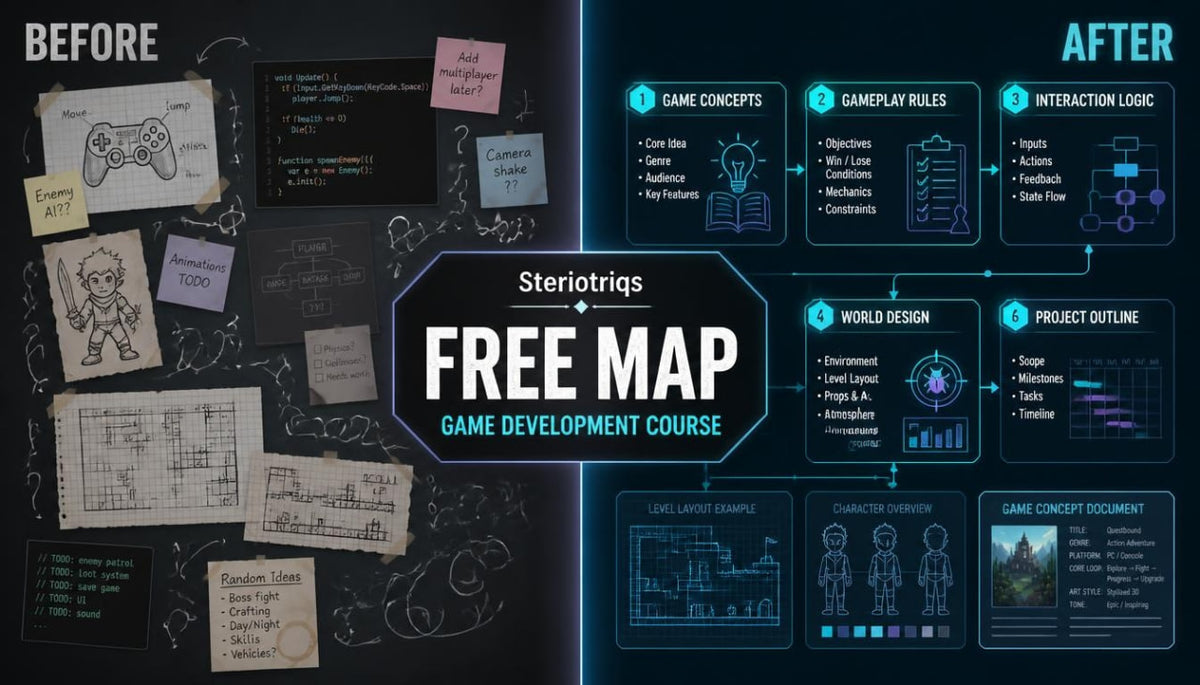
Free Map presents game development as a connected collection of creative and technical processes. The course begins with foundational terminology before examining how individual components contribute to interactive experiences. Each module introduces a specific topic through straightforward explanations and illustrative scenarios. Practical activities encourage learners to examine design decisions, outline simple mechanics, and organize ideas into manageable development tasks. By completing the course, learners will have explored the fundamental relationships between game concepts, player interactions, digital environments, and development workflows.
3. What's Inside
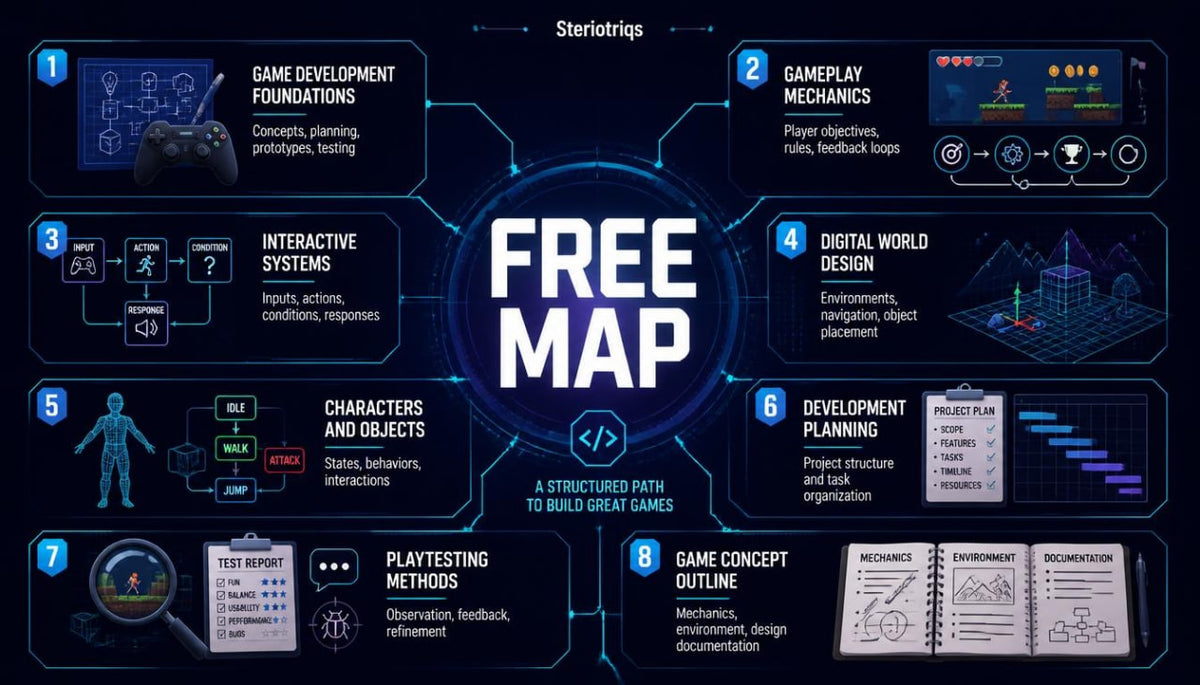
Module 1 — Understanding the Game Development Landscape
Explore the primary stages of game creation, from initial concepts and planning to prototype development, testing, and refinement. Examine the responsibilities involved in organizing an interactive project and how different development activities connect.
Module 2 — The Anatomy of Gameplay
Study gameplay loops, player objectives, challenges, rules, and feedback mechanisms. Learn how individual mechanics influence player decisions and contribute to the structure of an interactive experience.
Module 3 — Thinking in Interactive Systems
Examine inputs, actions, conditions, and responses as connected elements within a game. Explore introductory logic structures and use simple examples to describe how interactive events operate.
Module 4 — Building Digital Worlds on Paper
Discover foundational approaches to environment planning, spatial organization, navigation routes, and object placement. Practice sketching a small playable area and describing its intended interactions.
Module 5 — Characters, Objects, and Behaviors
Learn how characters and interactive objects can be described through properties, states, and behaviors. Examine movement rules, collisions, interactions, and basic state changes through conceptual examples.
Module 6 — From Ideas to Development Plans
Explore methods for organizing game concepts into concise design documents. Practice defining project boundaries, identifying core mechanics, and dividing development activities into smaller tasks.
Module 7 — Testing the Player Experience
Study introductory playtesting principles, observation methods, and the role of feedback in design refinement. Learn how to identify unclear interactions and document possible adjustments.
Module 8 — Your First Game Concept Outline
Bring the course topics together by preparing a compact game concept document describing a fictional game's objectives, primary mechanics, environment, interaction rules, and testing considerations.
4. Who Is This For?
Free Map is intended for curious beginners exploring game development for the first time. It also suits creative learners who want to understand the connection between game design and technical systems before studying more detailed subjects.
The course focuses on introductory concepts rather than advanced implementation or complete game construction.
5. What You'll Learn
-
Identify the primary stages of game development.
-
Explain fundamental gameplay loops and mechanics.
-
Describe player interaction using basic logic structures.
-
Outline introductory character and object behaviors.
-
Plan a small interactive environment.
-
Organize a game idea into a structured concept document.
-
Recognize basic playtesting and refinement methods.
6. 14-Day Refund Policy
Free Map is provided without a purchase charge, so no payment refund is necessary.
For paid Steriotriqs courses, customers may submit refund requests within 14 days of purchase, subject to the conditions described in our Refund Policy. Requests can be directed to our support team for review.
Share