Steriotriqs
Lattice Module
Lattice Module
Couldn't load pickup availability
1. Problem Statement
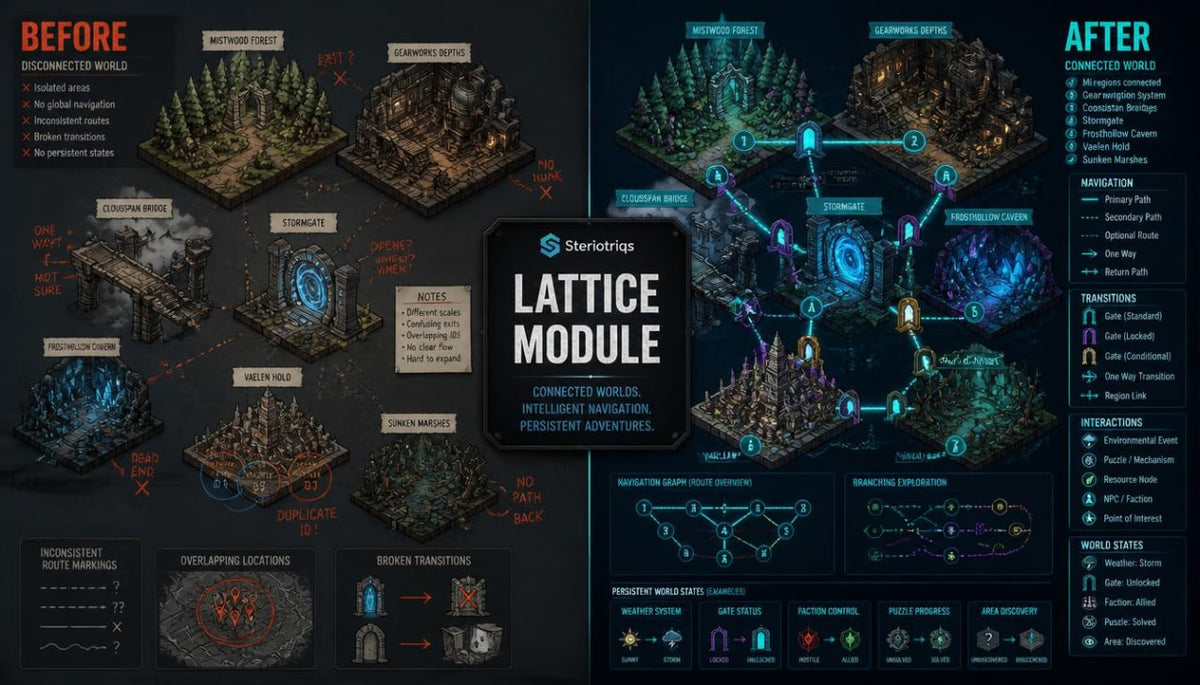
Designing interconnected game environments requires coordination between spatial layouts, navigation routes, interactive objects, and gameplay systems. Individual locations must function independently while maintaining meaningful relationships with surrounding areas. Poorly organized world structures can create navigation conflicts, inconsistent environmental behavior, and confusing progression conditions. Developers must also consider how player actions influence different locations and how these changes are represented throughout the environment. Understanding these relationships provides a foundation for designing coherent and technically structured game worlds.
2. Solution
Lattice Module introduces systematic methods for planning connected environments and documenting their underlying structures. The course examines spatial organization, navigation networks, regional transitions, and environmental interaction rules. Learners investigate how individual locations communicate through shared conditions, events, and persistent gameplay states. Practical activities guide participants through creating world diagrams, route specifications, interaction maps, and evaluation procedures. A comprehensive applied studio combines these concepts into a documented fictional game world containing interconnected regions and dynamic environmental systems.
3. What's Inside
Module 1 — Architecture of Connected Game Worlds
Examine how individual levels form larger interactive environments. Study regional boundaries, spatial hierarchies, interconnected locations, and methods for organizing world structures into manageable development components.
Module 2 — Navigation Networks and Spatial Connections
Explore navigation graphs, traversal routes, directional connections, and environmental pathways. Practice creating spatial diagrams describing how players travel between locations under different gameplay conditions.
Module 3 — Designing Regional Transitions
Investigate transitions between interconnected environments, including entry points, transition triggers, and location-specific conditions. Develop documentation describing how gameplay states are maintained during movement between regions.
Module 4 — Environmental Interaction Networks
Study how switches, doors, mechanisms, environmental objects, and regional events influence connected locations. Construct dependency diagrams showing how interactions in one area affect conditions elsewhere.
Module 5 — Persistent World States
Explore methods for representing environmental changes that remain relevant after players leave a location. Examine state records, event conditions, regional updates, and relationships between persistent objects.
Module 6 — World Progression and Exploration
Investigate branching routes, conditional pathways, environmental obstacles, and interconnected objectives. Create progression maps that describe how exploration decisions influence available routes and gameplay interactions.
Module 7 — Evaluating Connected Environments
Study approaches to reviewing navigation continuity, conflicting interaction rules, regional dependencies, and persistent conditions. Develop testing scenarios involving repeated visits, interrupted transitions, and changing environmental states.
Module 8 — Applied Studio: The Lattice Frontier
Design a fictional exploration world containing several connected regions, environmental mechanisms, alternative routes, and persistent gameplay conditions.
Prepare a world map, navigation graph, transition specifications, event dependency diagrams, state records, and structured evaluation checklist.
4. Who Is This For?
Lattice Module is intended for learners familiar with gameplay mechanics, environmental design, and introductory system architecture.
It is particularly relevant to individuals interested in level design, connected-world structures, exploration mechanics, and environmental interaction planning.
The course emphasizes architectural reasoning and practical documentation rather than complete game implementation.
5. What You'll Learn
- Plan interconnected game environments.
- Create navigation graphs and regional maps.
- Define transitions between gameplay locations.
- Document environmental interaction dependencies.
- Describe persistent world-state mechanisms.
- Organize branching exploration routes.
- Identify structural conflicts between connected regions.
- Develop evaluation scenarios for complex environments.
- Prepare comprehensive world architecture documentation.
6. 14-Day Refund Policy
Customers may submit a refund request within 14 days of purchasing Lattice Module, subject to the Steriotriqs Refund Policy and applicable consumer rights.
Requests can be submitted through our contact channel with the relevant order information. Our support team will review each request according to the published refund conditions.
Share