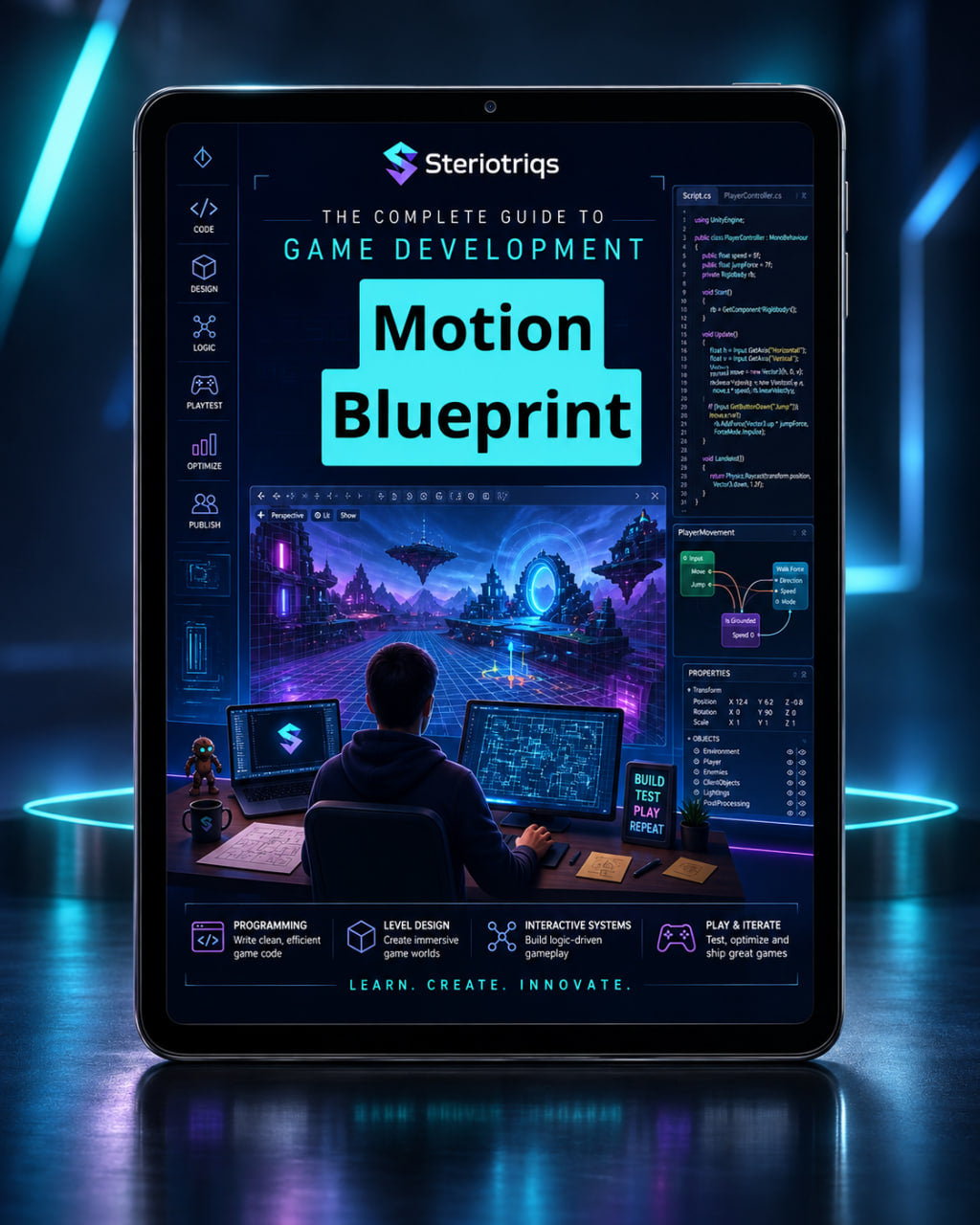
Steriotriqs
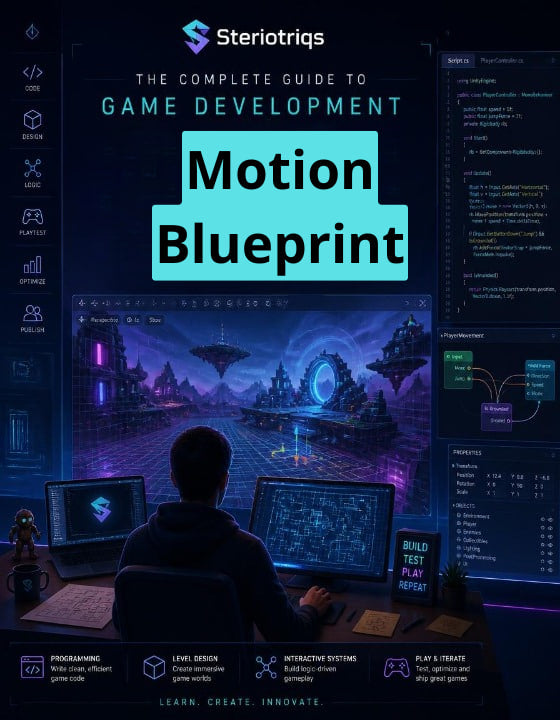
Motion Blueprint
Motion Blueprint
Couldn't load pickup availability
1. Problem Statement
Movement plays a central role in how players interact with characters, objects, and digital environments. Designing consistent motion requires an understanding of timing, spatial relationships, animation states, and gameplay conditions. When these elements are developed independently, interactions may produce conflicting behaviors or unexpected visual responses. Camera movement, environmental transitions, and object animation introduce additional relationships that require careful coordination. A structured approach to motion design helps learners examine how these systems function together within an interactive experience.
2. Solution
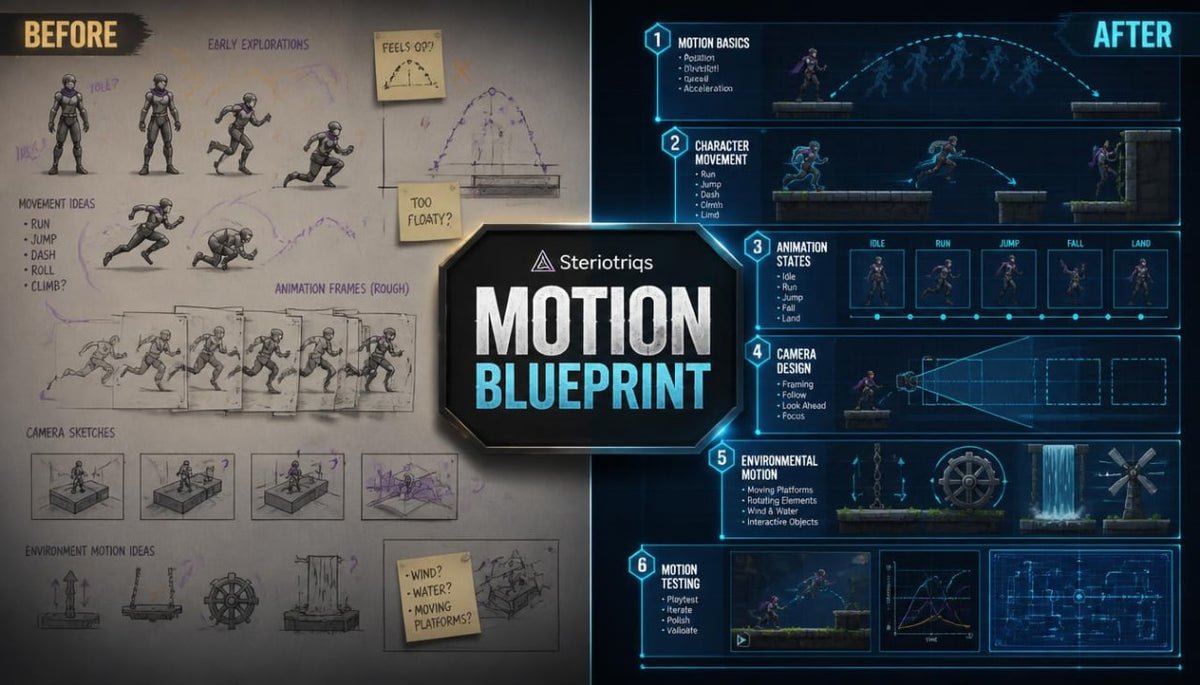
Motion Blueprint introduces methods for planning, describing, and evaluating movement systems within game development projects. The course explores how spatial calculations, timing rules, animation states, and camera behavior influence interactive motion. Learners examine fictional gameplay scenarios that demonstrate relationships between character movement, environmental objects, and visual feedback. Practical exercises focus on preparing motion diagrams, transition charts, behavior specifications, and evaluation procedures. An integrated studio connects these concepts within a documented interactive environment containing coordinated movement systems.
3. What's Inside
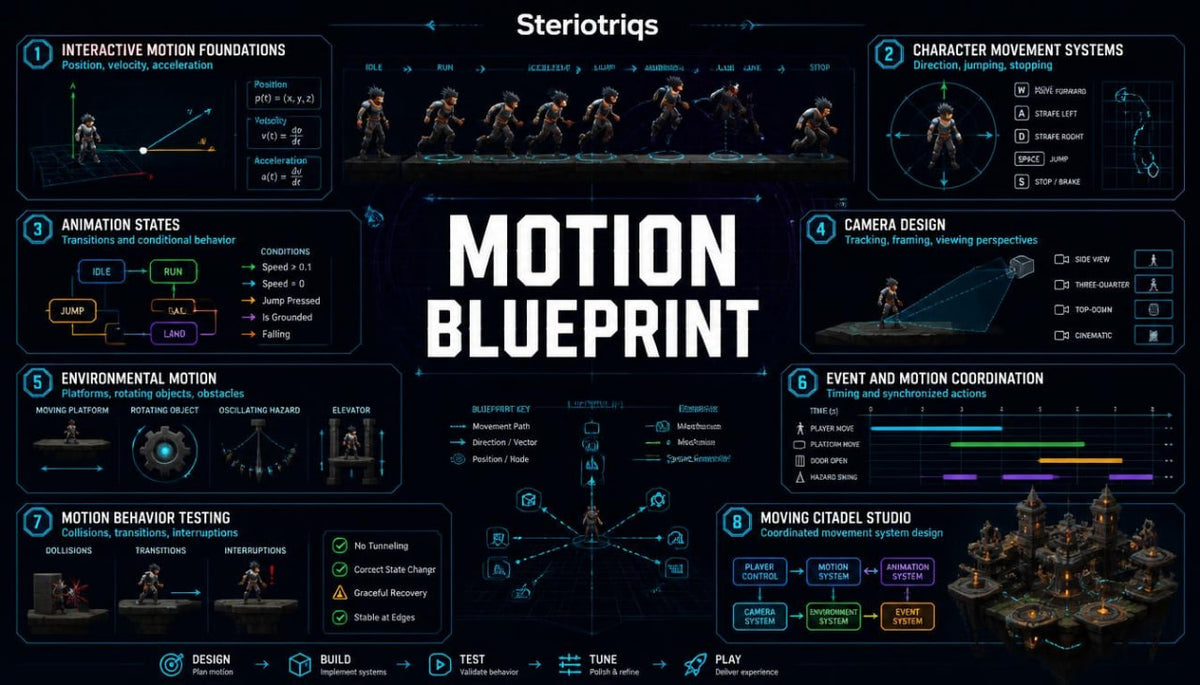
Module 1 — Foundations of Interactive Motion
Examine how position, direction, velocity, and acceleration describe movement within digital environments.
Explore coordinate systems, movement vectors, and spatial relationships through practical examples involving characters and movable objects.
Module 2 — Designing Character Movement Systems
Study directional movement, acceleration curves, stopping behavior, jumping mechanics, and movement restrictions.
Compare alternative movement configurations and document their relationships with player input and environmental conditions.
Module 3 — Animation States and Transitions
Explore how animation systems represent character actions through states, transitions, and conditional rules.
Create state diagrams describing transitions between standing, walking, jumping, landing, and interacting.
Module 4 — Camera Movement and Spatial Framing
Investigate camera positioning, tracking behavior, movement boundaries, and changes in viewing perspective.
Develop camera specifications for fictional environments containing different spatial layouts and movement challenges.
Module 5 — Environmental Motion and Moving Objects
Examine moving platforms, rotating mechanisms, sliding obstacles, and animated environmental elements.
Study movement paths, timing sequences, repeated motion cycles, and interactions between moving objects and characters.
Module 6 — Coordinating Motion with Gameplay Events
Explore how gameplay events initiate, interrupt, or modify motion sequences.
Examine event ordering, movement restrictions, animation synchronization, and conditional transitions through connected gameplay scenarios.
Module 7 — Motion Testing and Behavior Analysis
Study methods for reviewing movement consistency, timing conflicts, animation transitions, and camera responses.
Prepare evaluation scenarios covering repeated actions, interrupted movement, collision boundaries, and unexpected state changes.
Module 8 — Applied Studio: The Moving Citadel
Design a fictional interactive environment featuring character movement, animated mechanisms, moving platforms, and responsive camera behavior.
Prepare motion diagrams, animation state charts, movement specifications, event sequences, and a structured evaluation checklist.
4. Who Is This For?
Motion Blueprint is intended for learners with foundational knowledge of game mechanics, interaction systems, and development planning.
It is particularly relevant to individuals interested in character movement, animation coordination, environmental motion, and camera design.
The course emphasizes technical concepts, system documentation, and applied design activities rather than delivering a finished playable game.
5. What You'll Learn
- Describe movement using position, velocity, and acceleration.
- Plan character movement and directional behavior.
- Create animation state and transition diagrams.
- Document camera tracking and positioning rules.
- Design movement patterns for environmental objects.
- Coordinate motion sequences with gameplay events.
- Identify timing and interaction conflicts.
- Develop movement evaluation scenarios.
- Prepare specifications for interconnected motion systems.
6. 14-Day Refund Policy
Customers may submit a refund request within 14 days of purchasing Motion Blueprint, subject to the conditions outlined in the Steriotriqs Refund Policy and applicable consumer rights.
Requests can be submitted through our contact channel with the relevant order details. Our support team will review each request according to the published refund conditions.
Share