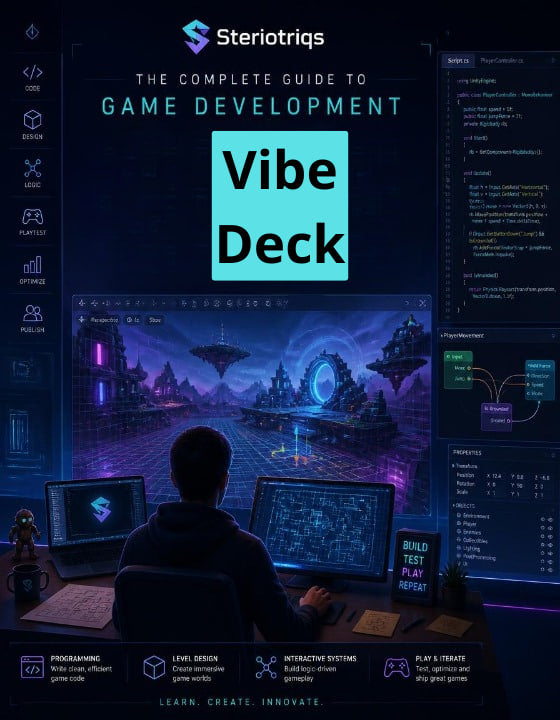
Steriotriqs
Vibe Deck
Vibe Deck
Couldn't load pickup availability
1. Problem Statement
Gameplay mechanics often appear straightforward when described as individual actions, yet their behavior depends on several interconnected design decisions. Movement speed, action timing, environmental boundaries, and feedback signals can influence how players interpret interactive situations. Without understanding these relationships, learners may find it difficult to describe why certain mechanics feel consistent while others create confusion. Designing responsive interactions also requires attention to the conditions that control when actions begin, change, or end. A structured examination of these elements helps learners develop a clearer understanding of gameplay behavior and interaction design.
2. Solution
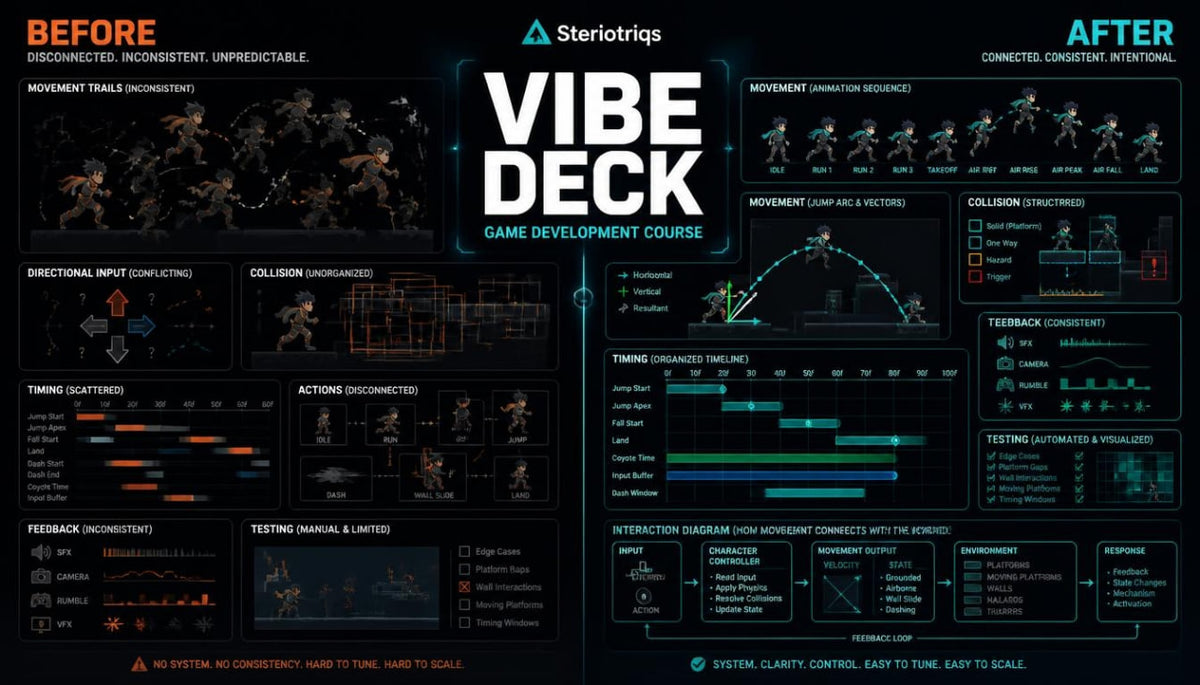
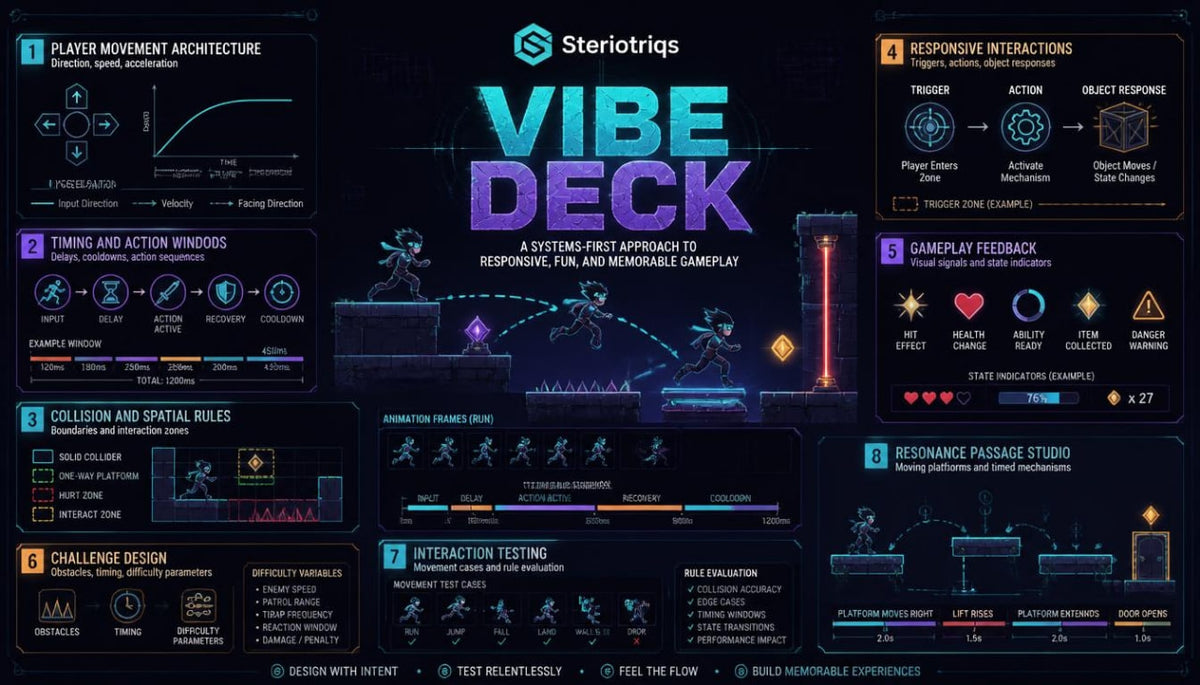
Vibe Deck introduces a practical framework for examining player movement, interaction timing, and environmental responses. The course divides gameplay behavior into identifiable components that can be described, compared, and adjusted independently. Learners investigate how movement rules, collision boundaries, action sequences, and feedback mechanisms interact within a fictional game scenario. Each module combines technical concepts with structured design examples and written exercises. An applied design project brings these subjects together through the development of a documented interactive challenge.
3. What's Inside
Module 1 — The Architecture of Player Movement
Explore how movement systems interpret directional input and produce changes in character position. Study movement speed, acceleration, deceleration, directional control, and environmental constraints.
Practice creating a movement specification that defines how a fictional character responds to different input conditions.
Module 2 — Timing, Rhythm, and Action Windows
Examine how timing influences jumping, interacting, collecting objects, and completing action sequences. Study delays, durations, cooldown periods, and transitions between gameplay actions.
Develop a timeline showing how a character moves through several connected interaction states.
Module 3 — Spatial Rules and Collision Boundaries
Investigate how collision shapes, movement restrictions, and object boundaries influence navigation through digital environments.
Explore collision detection concepts, overlapping objects, solid surfaces, and interaction zones through illustrated scenarios and spatial diagrams.
Module 4 — Building Responsive Interaction Sequences
Study the structure of interactive actions involving triggers, conditions, responses, and state changes.
Examine examples involving doors, moving platforms, collectible objects, and environmental mechanisms. Create an interaction map connecting individual actions to their corresponding outcomes.
Module 5 — Feedback That Communicates Gameplay
Explore how visual changes, interface indicators, object movement, and environmental responses communicate information about player actions.
Learn to distinguish between immediate action feedback, continuing state indicators, and signals that communicate unavailable interactions.
Module 6 — Balancing Challenge and Player Understanding
Examine how obstacle placement, interaction timing, and mechanic combinations influence the structure of gameplay challenges.
Practice comparing several versions of a fictional challenge and documenting how adjustments affect its intended behavior.
Module 7 — Testing and Refining Interaction Rules
Study methods for reviewing gameplay specifications, identifying conflicting rules, and examining unexpected interaction sequences.
Create test cases for movement boundaries, interrupted actions, repeated inputs, and combinations of gameplay events.
Module 8 — Applied Studio: The Resonance Passage
Design a fictional interactive environment containing moving platforms, timed mechanisms, environmental obstacles, and collectible objects.
Prepare movement specifications, event diagrams, timing charts, feedback rules, and a structured testing plan. Review how the individual mechanics connect to form one coherent gameplay sequence.
4. Who Is This For?
Vibe Deck is intended for learners who understand introductory game development concepts and want to explore the structure of player movement and gameplay interactions.
It is particularly relevant to individuals interested in character mechanics, environmental challenges, interaction timing, and gameplay design documentation.
The course focuses on conceptual system development and applied planning. It does not provide a complete playable game or advanced implementation training.
5. What You'll Learn
- Describe movement rules using structured specifications.
- Explain acceleration, deceleration, and directional control.
- Identify timing relationships between gameplay actions.
- Outline collision boundaries and interaction zones.
- Develop event sequences for environmental mechanisms.
- Design feedback rules for different gameplay states.
- Compare obstacle configurations and interaction conditions.
- Create gameplay testing scenarios.
- Prepare documentation for an interconnected interactive environment.
6. 14-Day Refund Policy
Customers may submit a refund request within 14 days of purchasing Vibe Deck, subject to the conditions described in the Steriotriqs Refund Policy.
Requests can be submitted through our contact channel with the relevant order information. Our support team will review each request according to the published policy and applicable consumer rights.
Further details about refund eligibility and request procedures are provided in the complete Refund Policy.
Share